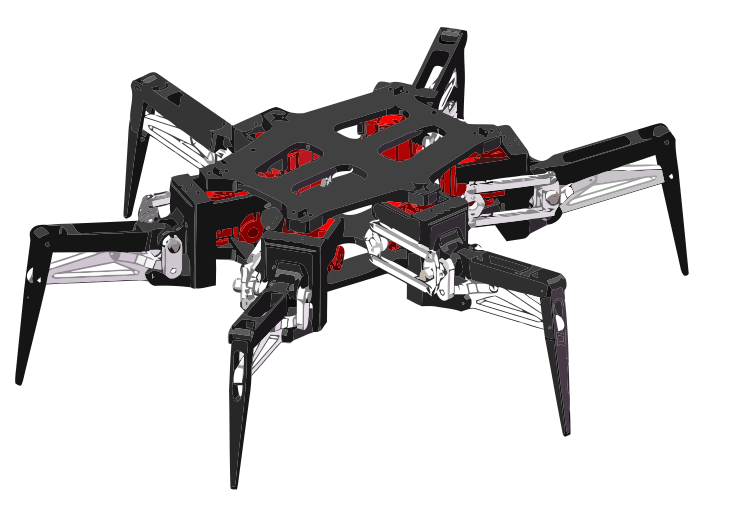
Independent horizontal swing and vertical lift drives support research into foot trajectories, support timing and biomimetic gaits, alongside robotics education and mechanism analysis.
Six-legged, six-bar-linkage research prototype · Structural model
Legs
6 legs
Active DOF per leg
2
Bus-controlled servos
12
Gaits studied
2
Research prototype data
Research specifications
The following data describe the six-legged research prototype reported in the paper.
Six-legged, six-bar-linkage research prototype
Mechanical design
Six legs, each with a six-bar lifting mechanism
Drive configuration
Two bus-controlled servos per leg; 12 drives in total
Active degrees of freedom
Two per leg: horizontal swing and vertical lift
Gaits
Tripod and two-leg-support gaits
Peak speed, two-leg-support gait
0.390 m/sMeasured on the research prototype
Average speed, two-leg-support gait
0.174 m/sSame 20-second experiment
Test conditions: 20 seconds of forward travel on a level laboratory floor, with servo speed set to 0.2 revolutions per second. Speed was estimated by integrating acceleration from a nine-axis IMU. These are published research results, not delivery specifications. Dimensions, mass, payload, runtime and interfaces depend on the specific prototype and test results.
How it moves
Mechanism and gaits
From single-leg motion to coordinated multi-leg walking.
01
Independent swing and lift
One servo controls horizontal swing; the other drives vertical lift through a six-bar linkage. The lifting mechanism has one degree of freedom, making the relationship between input angle and foot trajectory easier to analyze.
02
Tripod gait
Two groups of three legs provide alternating support. Static stability is possible when the center-of-mass projection remains inside the support triangle, making this gait suitable for initial testing and support-timing research.
03
Two-leg-support gait
Three pairs of legs provide alternating support, requiring dynamic balance. The published experiment recorded higher speed and greater body vibration with this gait, providing a basis for studying speed and stability.
Motion demonstrations
Demonstrations
Mechanism motion, physical walking tests and simulation comparisons.
HX1 · Gait and simulationBiomimetic spider · Mechanism and gait research
The videos show prototypes from different development stages. Refer to the documentation for each prototype's structure and configuration.
Preparing an experiment
Operating guidance
Guidance for introductory teaching and experimental preparation.
Inspection and calibration
Check power requirements, fasteners and wiring. Verify servo neutral positions and joint directions using the hardware instructions.
Low-speed testing
Start with the tripod gait on level, unobstructed ground. Check foot clearance, support sequence and motion limits.
Records and maintenance
Adjust gait parameters incrementally and record speed, posture and temperature rise. Stop and inspect if binding or abnormal vibration occurs.
Follow the hardware documentation for initial power-up, emergency stopping and software operation.
Technical source and model image: Ma et al., Micromachines 13(9), 1404 (2022), Fig. 3 (cropped), CC BY 4.0.