
Open frame
Inspect wiring and adjust equipment placement easily during hardware integration and motion-control experiments.
OriginMind · Education and research
PW1-EDU combines parallel-linkage legs with an open frame for equipment installation, debugging and motion-control experiments.
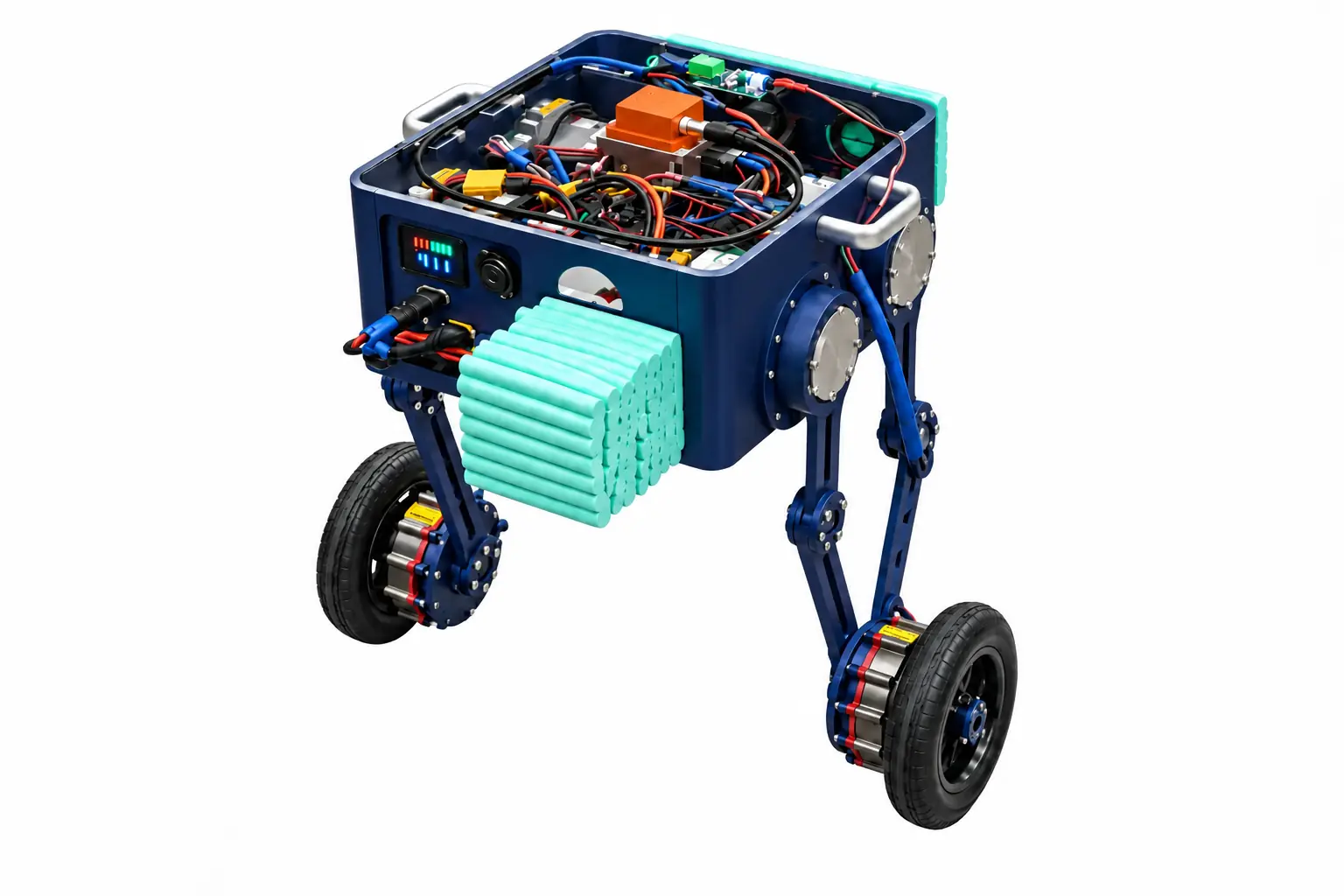
Prototype
| Robot type | Wheel-legged |
|---|---|
| Body | Open frame |
| Experimental tasks | Wiring and debugging, sensor installation and motion-control experiments |
An education and research prototype for teaching, demonstrations and experimental validation.
Discuss research collaborationAn open frame provides access for hardware integration and motion experiments.
Inspect wiring and adjust equipment placement easily during hardware integration and motion-control experiments.
Parallel linkages and wheel drives provide a platform for posture control and coordinated motion experiments.
Recorded tests show straight-line travel, turning, slope traversal and body-height adjustment, making wheel-and-leg coordination visible.
| Development focus | Onboard wiring, equipment installation and motion control |
|---|---|
| Configuration requirements | Control interfaces, computing, sensors and power requirements |
Share the computers and sensors you plan to use, mounting dimensions, power requirements and intended experiments so we can define the configuration and evaluation criteria.
For experiments that require frequent changes to hardware and software configurations.
Use physical hardware to explain the relationship between wheel-and-leg mechanisms, onboard electronics and motion control.
Assess experimental configurations for computing, sensors, power and communications.
Design experiments around target movements, observe the robot response and adjust control strategies.
Key checks for installation, commissioning, operation, shutdown and maintenance.
With power disconnected, check fasteners, linkage clearance and cable slack, then confirm supply polarity and interface definitions. On first power-up, read system status before enabling motion. With secure support and protective measures in place, verify zero positions, motion directions and stop functions before limited, low-speed testing.
Confirm the initial posture and commands using the instructions for the specific prototype. On level ground with protective measures in place, test straight-line travel, turning and height adjustment individually at limited speed. To shut down, end the motion task and establish stable support, then disable drives, shut down and disconnect power in the specified order. Stopping travel does not disable the drives.
Before software development, confirm the protocol, node IDs, units and limits; for CAN, also confirm the bus type and bit rate. Inspect linkages, tires, wiring and batteries before and after use. Stop testing and retain logs if abnormal oscillation, binding or communication loss occurs.
Use the configuration and instructions for the specific prototype to confirm power requirements, pinouts, motion limits and stop procedures.
Laboratory and outdoor recordings show travel, turning, slope traversal and posture adjustment.
The videos document prototypes under test. Results depend on the surface, payload and control configuration; performance must be validated for the intended application.
Plan experiments using the mechanical design, recorded demonstrations and robotics courses.
Review installation checks, initial commissioning, operation, shutdown and maintenance guidance.
Read operating guidanceExplore robotics fundamentals, control methods and system integration alongside the platform designs and task demonstrations on this page.
Explore robotics courses (Chinese)Use the travel, turning and height-adjustment demonstrations to examine the relationship between mechanism posture and whole-robot motion.
Watch demonstrationsControl software, interface documentation and example code for this model are being prepared. Before operating hardware, confirm the instructions and interface definitions for the specific prototype.